Do I Really Need a Deep Cleaning? How to Tell
Told you need a deep cleaning and not sure you believe it? Here's how a deep cleaning differs from a regular cleaning, what your gum numbers mean, what evidence should back up the recommendation, and what to ask before you say yes.
By Dr. Noah B. Honig, DMD · November 5, 2026 · 6 min read
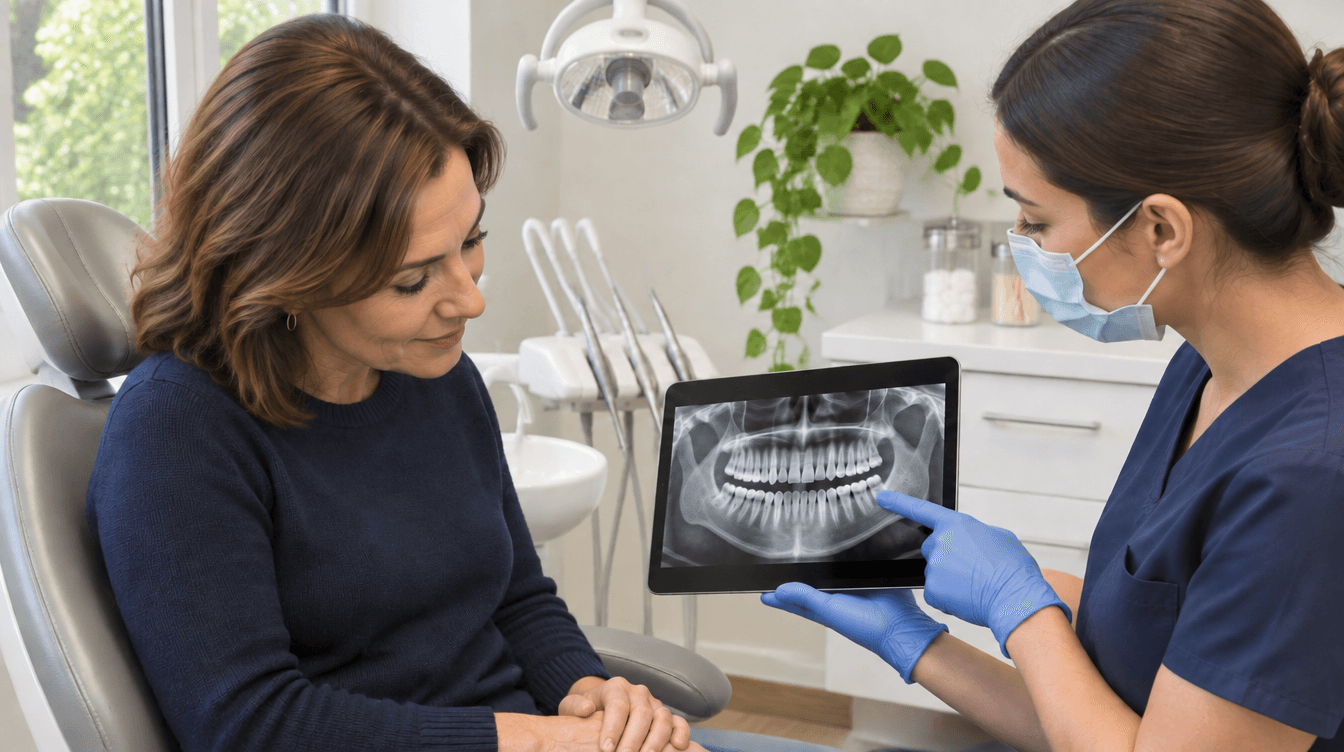
Why it's fair to question a deep cleaning
You came in for a regular cleaning and left with a recommendation for a deep one. It takes 1 to 2 hours, it involves numbing, and it's billed as its own treatment, so it's reasonable to wonder whether you really need it.
Here's what helps: a deep cleaning isn't a premium version of a regular cleaning. It's a treatment for gum disease, and gum disease leaves evidence you can look at. You don't have to take the recommendation on faith.
It isn't automatically suspicious, either. A CDC-led analysis of national survey data from 2009 to 2014 estimated that 42% of US adults 30 and older with natural teeth had periodontitis, the form of gum disease that damages the tissue and bone holding teeth in place. About 7.8% had severe periodontitis. And according to Cleveland Clinic, gum disease is usually painless, especially in the early stages, so feeling fine doesn't rule it out.
Deep cleaning vs. regular cleaning: what's different
Cleveland Clinic describes a deep cleaning, formally called scaling and root planing, as "sort of like a regular dental cleaning, except it reaches deeper beneath your gums."
- Regular cleaning: routine care. At our office, plaque and tartar come off, then your teeth get polished.
- Deep cleaning: treatment for periodontitis, where gum disease has started to cost you the tissue and bone that support the tooth.
- What happens in a deep cleaning: your gums are numbed, plaque and tartar are removed above and below the gumline, and the root surfaces are smoothed.
- How much of your mouth: a deep cleaning doesn't have to cover everything. The ADA's claim codes separately cover 1 to 3 teeth in a quadrant (a quarter of your mouth) and 4 or more.
What your gum numbers mean
During a gum check, a thin probe marked in millimeters slides between each tooth and the gum, and someone calls out numbers.
One number doesn't settle it, though. The ADA points out that inflamed gums can give a deeper reading with no bone loss at all, sometimes called a pseudo-pocket, and that attachment loss, measured from a fixed point on the tooth, is a more stable indicator.
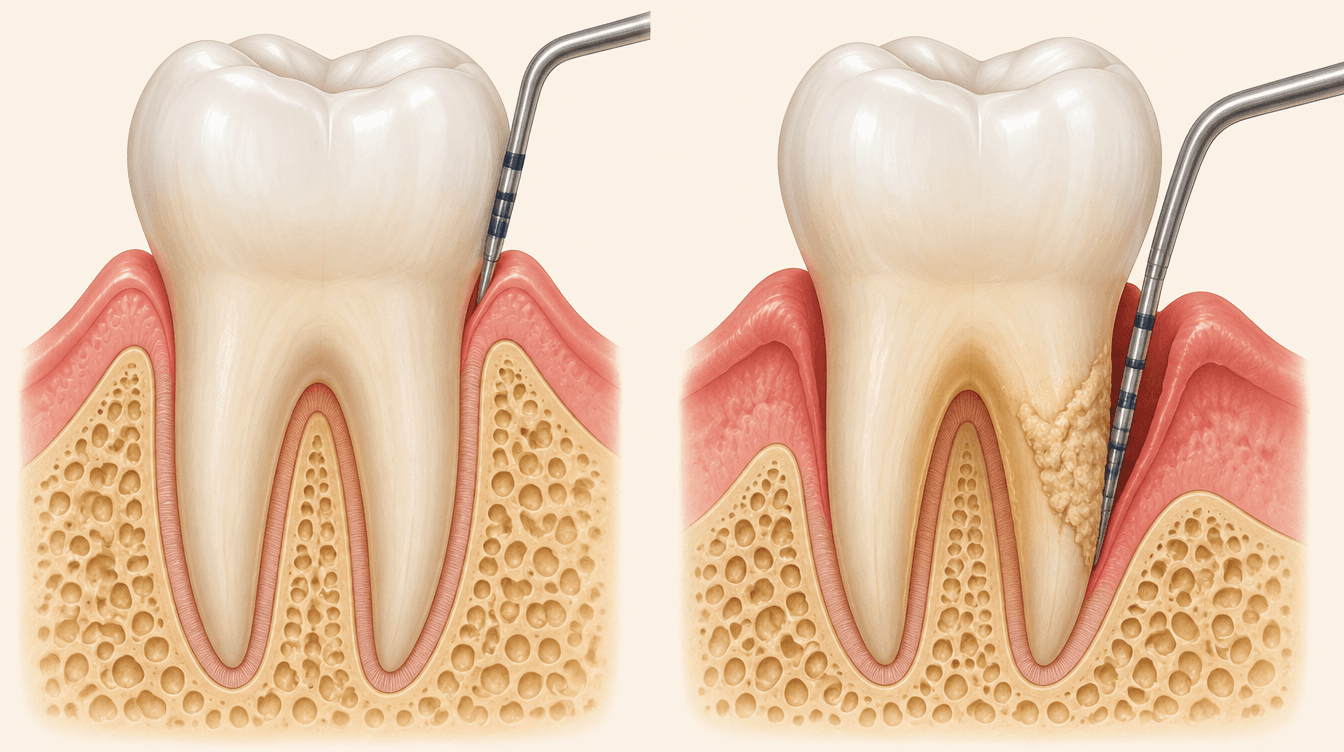
- 3mm or less: the range the European and American periodontal societies (EFP/AAP) use to define health in gums that haven't lost support.
- Bleeding: that definition also looks for bleeding at fewer than 10% of the spots measured, though a 2020 systematic review found no clear evidence behind the exact cutoffs.
- 4mm or more: deeper than that healthy range and worth a closer look. In the CDC analysis, about 15% of adults 30 and older had readings this deep at 5% or more of the spots measured.
- After past tissue loss: the same definition allows up to 4mm, with limited bleeding. The 2020 review says it's uncertain whether that works as a treatment goal, so ask what your readings mean for you.
What should justify a deep cleaning
ADA clinical recommendations say clinicians should consider scaling and root planing as the initial treatment for chronic periodontitis. The ADA's claims guide uses the American Academy of Periodontology's definition of periodontitis, which centers on attachment loss at 2 or more teeth that isn't explained by something else, like a cavity or a cracked root. Attachment loss means the tissue holding the tooth has been lost along the root. Here's what to ask to see in your records.
- Attachment loss, charted tooth by tooth
- Pocket depths at 6 or more spots around each affected tooth, which the ADA says proper charting typically includes
- Bleeding when the gums are probed, a sign of inflammation
- Bone loss on X-rays of those teeth
- Tartar on the root surfaces, which some insurers also require
When you may not need one
If your gums are inflamed but there's no bone loss or attachment loss, root planing may not be the right treatment. The ADA says that situation should be reported as a regular cleaning, or as a separate full-mouth scaling for moderate or severe gum inflammation after an exam.
Gingivitis, the earliest stage, involves no bone loss and is reversible with proper treatment, according to Cleveland Clinic. Insurers draw their own lines. Policies quoted in the ADA's claims guide vary: some want pockets of at least 4mm plus bone loss on X-rays, one generally looks for 5mm to 8mm, and one says root planing isn't indicated for heavy buildup without attachment loss. The ADA notes that a denial over plan limits doesn't mean the treatment was unnecessary. Still, a lot of buildup doesn't necessarily add up to a deep cleaning on its own.
Questions to ask before you say yes
It's reasonable to get a second opinion before a big treatment plan. Ask for copies of your X-rays and have the second office measure your gums itself. Sometimes that changes the plan and sometimes it confirms it, and both answers are useful. Just don't let the question drag on for years. Cleveland Clinic warns that untreated gum disease can destroy the underlying jawbone and lead to loose teeth and possible tooth loss.
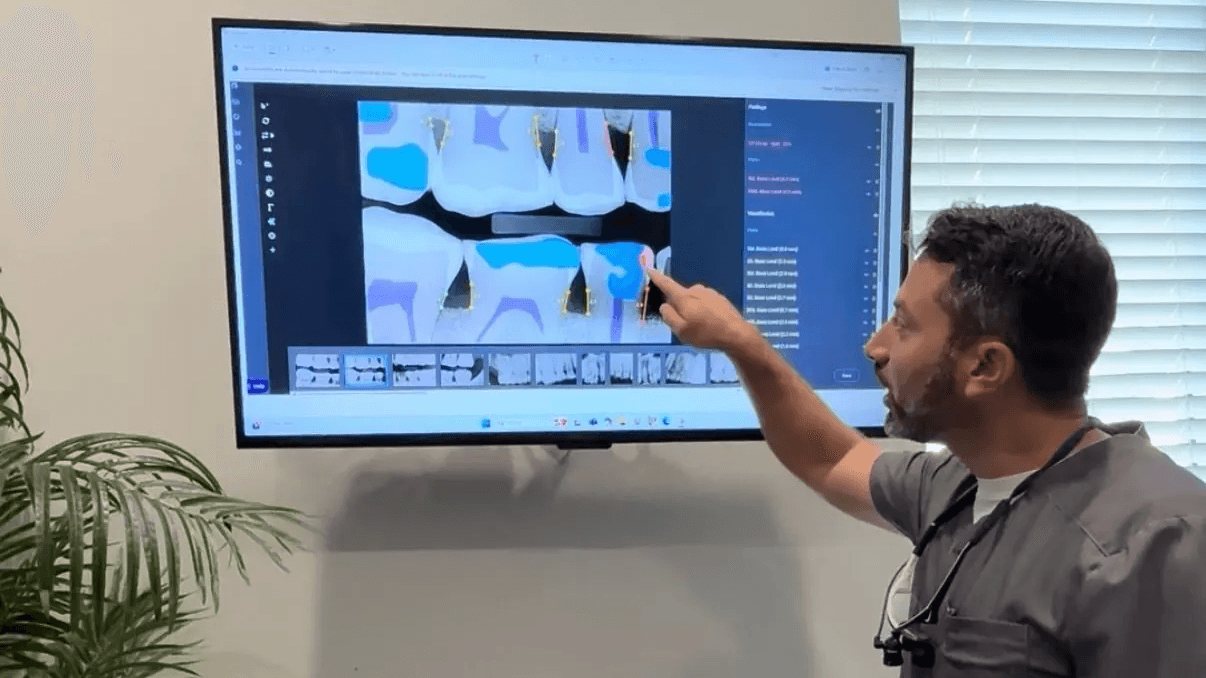
- Which teeth have readings of 4mm or more, and can you show me on my chart?
- Where do you see bone loss on my X-rays?
- Do I have attachment loss, or could this be swelling from gingivitis?
- Does this need to cover my whole mouth, or just certain teeth?
- What will you check afterward, and how often will I need to come back?
- What will this cost me after insurance?
What the visit and recovery are like
According to Cleveland Clinic, a deep cleaning takes 1 to 2 hours, and your dentist might finish in one visit or split it across two. Check your plan first, since some don't cover more than 2 quadrants in a day. You'll get local anesthesia to numb your gums, and there are no incisions or stitches. Most people go back to their normal routine the same day.
Let your dentist know if you have bleeding that doesn't stop, pain that doesn't get better with medication, or severe swelling. Otherwise, you may notice the following.
- Sore gums for a couple of days, which over-the-counter pain relievers can help
- Some bleeding, which is normal
- Teeth that feel a little loose until your gums tighten back up
- Sensitivity to heat and cold that should fade in a month or two
- More of the tooth root showing as swollen gums shrink
What a deep cleaning can't do
We'd rather be straight with you: the average gain is modest. A 2015 ADA panel review found, with moderate certainty, about a 0.5mm average improvement in clinical attachment with scaling and root planing. Even so, it's the first treatment ADA recommendations point clinicians to.
It also may not be the last step. Cleveland Clinic says people with moderate to advanced gum disease may need pocket reduction surgery, and that once you've lost support around your teeth, gum disease isn't curable but is manageable with proper treatment and consistent oral hygiene.
How we approach it at our Lutz office
We check gum health at every routine cleaning, and we tailor treatment to where you are, from early gingivitis to advanced periodontal disease. For deeper pockets, we may place Arestin, a localized antibiotic. We'll talk through next steps if surgery comes up. After treatment, patients typically move to maintenance cleanings every 3 to 4 months instead of the usual 6, because periodontal disease is managed long term.
We lay out your options up front, we're in network with most insurance plans, and we offer in-house membership plans plus financing through Cherry and CareCredit. If you've been told you need a deep cleaning, ask us to walk you through your chart and X-rays. Call (813) 906-5668 or schedule a consultation at our Lutz, FL office.
Frequently asked questions
Is a deep cleaning really necessary?
It's generally the recommended first treatment if you have periodontitis, which shows up as pockets, attachment loss and bone loss on X-rays. If your gums are inflamed with no bone loss, a regular cleaning or a scaling for gum inflammation may be the better fit.
What pocket depth needs a deep cleaning?
No single number decides it. Readings of 3mm or less with little bleeding fall in the healthy range, while insurance rules vary, from 4mm or more with bone loss on X-rays to, generally, 5mm to 8mm. Those are coverage rules, so your dentist should weigh depth, attachment loss, X-rays and bleeding together.
Does a deep cleaning hurt?
Your gums are numbed with local anesthesia during treatment. Afterward, they may be sore for a couple of days, and your teeth may be more sensitive to heat and cold for a month or two.
How long does a deep cleaning take?
Cleveland Clinic says 1 to 2 hours, in one visit or split across two. Most people return to their normal routine the same day.
What happens if I skip a deep cleaning I actually need?
Cleveland Clinic warns that untreated gum disease can destroy the underlying jawbone, which can cause teeth to become loose and eventually fall out.
Can I get a second opinion on a deep cleaning?
Yes, and it's a reasonable step before a big treatment plan. Ask for copies of your X-rays and have the second office take its own gum measurements.
- 1. CDC / JADA: Eke et al., Periodontitis in US Adults, NHANES 2009-2014 (2018)
- 2. International Journal of Dental Hygiene: Definitions used for a healthy periodontium, a systematic review (2020)
- 3. American Dental Association: Claims Submission, Scaling and Root Planing
- 4. Cleveland Clinic: Dental Deep Cleaning
- 5. Cleveland Clinic: Periodontal Disease (Gum Disease)
- 6. JADA: Smiley et al., Systematic review on scaling and root planing with or without adjuncts (2015)



Ready to talk about your smile?
We'll take a look, walk you through what's going on, and lay out your options before anything happens.